The Hack Report has an interview with Honeynet Founder Lance Spitzner where he gets to re-hash what we know about the bad guys: yes they are after your computer, they are in it for the money now and no, there’s nothing law enforcement can do.
And, of course, someone in the comments speaks up and denounces the use of the word ‘Hacker’ for the bad guys, since ‘Hacker’ really means ‘One who is proficient at using or programming a computer’ etc. etc. Of course I agree with this, but it’s too late to shut the barn door.
Give it up. The linguistic battle has been lost: in the eyes of the general public and the industry, ‘Hacker’ means you’re breaking stuff. End of story. Instead of mincing over words, let’s concentrate on actually fighting the bad guys. What we need is a new moniker for the ethical, the good guy hacker. Let’s rally under a new banner! From now on, the good guys should consider themselves ‘CyberPonies’.
Comments Off
I have been trying to say something useful about the Java Open Source announcement from Sun, but I keep running into the fact that I’d actually have to read the announcements before opening my mouth, and that simply has not happened.
So, let me simply say that I hope this eventually leads to having the JDK available in the FreeBSD package/ports collection, so one may install it from a package without having to download the source from one place and the patches from another and then spend the better part of a full day compiling your own JDK. Of course there are the Diablo JDK builds at the FreeBSD Foundation, but do those satisfy the dependencies of Java-based apps in the ports collection?
On another note, I have recently found some time to work on the documentation for the mod_ftp module. I’m transforming the documentation donated by Covalent into the format and layout used by the httpd documentation.
Comments Off
Nick Kew over at ApacheTutor reviews a couple of books on Apache Security. One of them, by Ryan Barnett, is already on my shelf. I’ll probably pick up Ivan Ristic’s book as well.
Comments Off
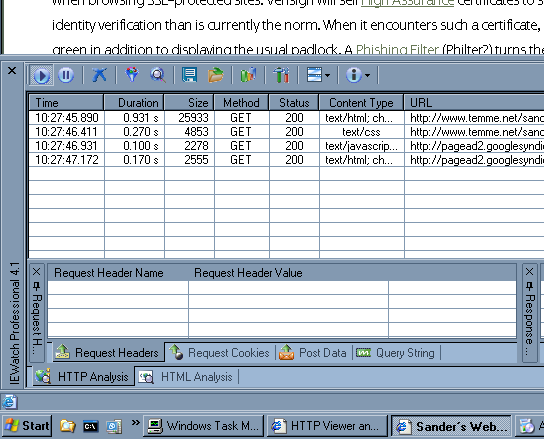
Several folks chimed in on my post about IEWatch last week. I also submitted IEWatch a sales support request asking for a Firefox version, and they said that there are no current plans, but “We might consider writing a compatible version if we receive enough customer requests.”
One of the compelling aspects about IEWatch is that it puts the connection information right into your browser window. At the cost of serious screen real estate, but we all have large monitors now, don’t we? None of the alternatives presented in the comments do this: even the Live HTTP Headers plugin for Firefox opens a separate window. In that window it dumps all the request and response headers in a fairly disorganized fashion, giving the user both too much information and too little. IEWatch neatly organizes the request and response headers, content, cookies etc. in the tabs across the bottom of the browser window.
Comments Off
If I were running Windows, this would actually make me use Internet Explorer more. The IEWatch gadget gives you an “underwater screen” that shows every HTTP transaction made when loading your pages. Great for troubleshooting and debugging, and you don’t have to run tcpdump or sift through mounds of traffic to piece together your web transaction flow. It almost makes up for IE’s atrocious error reporting, and because it shows every 404 or Redirect response that occurred has helped me tremendously in troubleshooting some weird edge case issues at customer installations.

So, dear Lazyweb, does anything like this exist for Firefox? Having this for Safari would be even better, but an IEWatch-like add-in would have the power to make me switch browsers on my Powerbook.